
Microstructure Evolution and Mechanical Properties in Friction Surfacing of Aluminum Alloys: Role of Deposition and Layer Formation Behavior, Process Parameters, Build Direction and Ambient Conditions
Autor: Marius Victor Hoffmann
ISBN: 978-3-69030-082-7
Dissertation, Leibniz Universität Hannover, 2025
Herausgeber der Reihe: Benjamin Klusemann
Band-Nr.: IPTS 03/2025
Umfang: 147 Seiten, 76 Abbildungen
Schlagworte: Friction surfacing, Multi-layer friction surfacing, Layer formation, Texture, Microstructure, Mechanical property
Kurzfassung: Friction surfacing (FS) is a solid-state deposition process that enables layer deposition using a consumable stud material by frictional heat and plastic deformation. Potential applications of the FS process range from repair tasks and coatings with enhanced corrosion or wear properties to additive manufacturing (AM) via a multi-layer approach. This work aims to understand the mechanisms for layer formation, their effect on layer properties, and the influence of process parameters, focusing on Al-Cu and Al-Mg alloys.
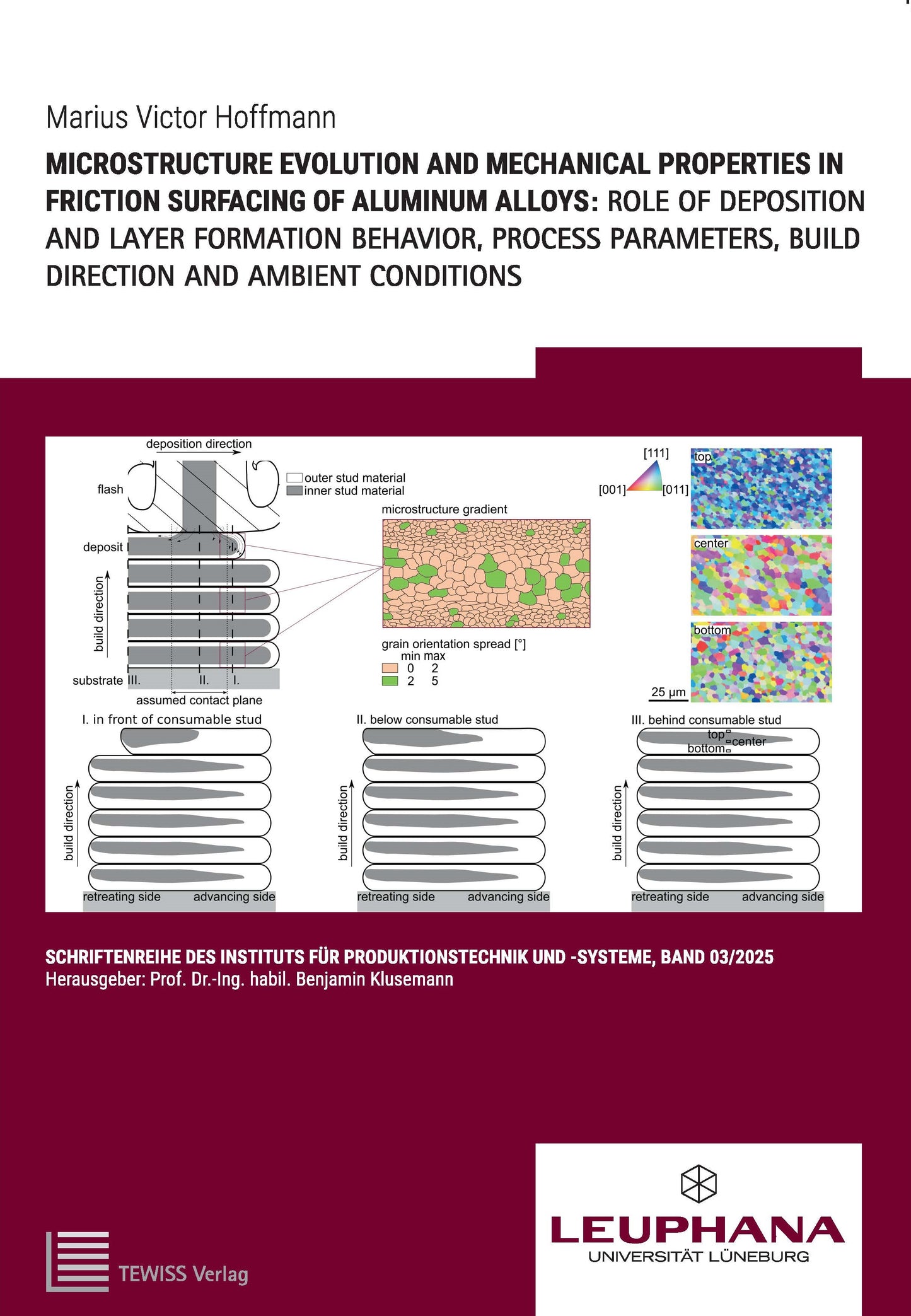
In single-layer FS investigations, a two-material consumable stud is deployed to visualize different characteristic parts of the layer. They were correlated with strain rates during deposition, resulting in microstructure variations. Additionally, the FS layer’s top shows shear texture components.
The multi-layer FS investigations revealed periodic microstructural gradients along stack height with refined grains and higher hardness in the layer interfaces. In precipitation-hardenable alloys, the influence of the precipitates on the mechanical properties dominates. Due to the thermal exposure of previous layers during the deposition of new layers, the microstructure overages and deteriorates the mechanical properties compared to the latest layers in the stacks.
Selected application examples show the economic potential of the process. FS is proving to be very promising for industrial applications and a promising AM alternative for high-strength aluminum alloys.