
From Process to Properties: Understanding Texture and Mechanical Behavior in AM50 rods Processed by Constrained Friction Processing
Autor*in: Camila Caroline de Castro
ISBN: 978-3-69030-149-7
Dissertation, Leibniz Universität Hannover, 2025
Herausgeber*in der Reihe: Prof. Dr.-Ing. habil. Benjamin Klusemann
Band-Nr.: IPTS 08/2025
Umfang: 145 Seiten, 79 Abbildungen
Schlagworte: Constrained friction processing, Mg alloys, microstructure, deformation mechanisms, enhanced ductility
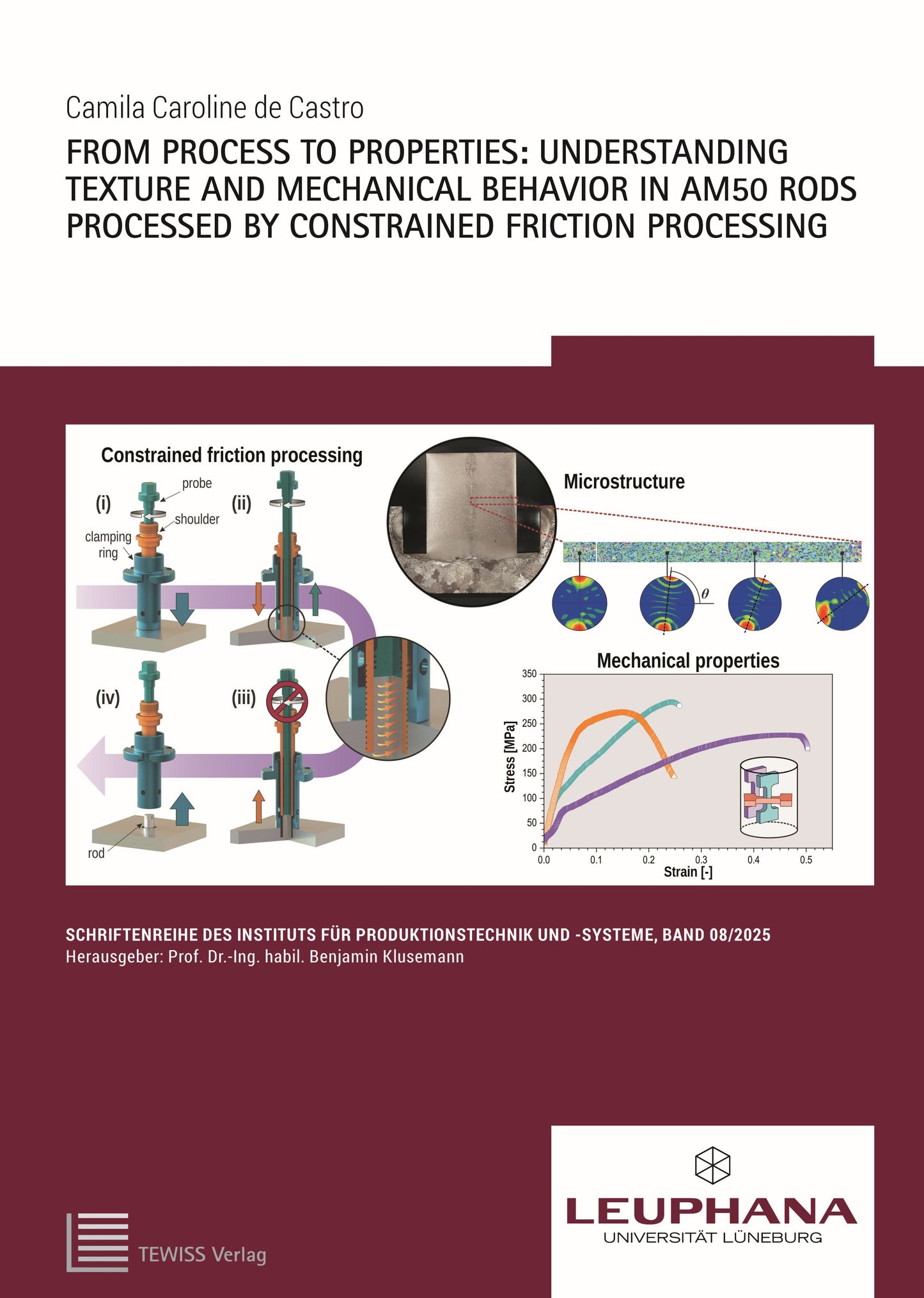
Kurzfassung: Constrained friction processing (CFP) is a new thermo-mechanical technique to produce rods from lightweight metals, like Mg or Al alloys, involving the extrusion of the material under high shear conditions induced by the rotation of the tools.
This work aims to introduce CFP as an effective technique for producing AM50 rods. The results show an exceptional grain refinement by a factor of 100 relative to the base material. Furthermore, the material flow formed during the process lead to the formation of a texture gradient ultrastrong in terms of intensity, characterized by the B-fiber texture at the center of the rod, which is increasingly tilted outward as the position approaches the edge. As a result, texture-dependent deformation mechanisms are activated, resulting in particular local mechanical properties along the rod. While all samples show significant improvements in ultimate tensile strength, notable enhancements in yield strength and ductility occur at the middle and center, with an exceptional increase in elongation at break observed at the outer portion of the rod.
The study demonstrates that texture tailoring can be achieved by controlling material flow during CFP, enabling an optimized balance between strength and ductility for specific applications. Furthermore, the enhanced properties indicate that this approach could pave the way for biomedical applications when combined with biocompatible Mg-based alloys, opening new avenues for material development.