
Numerical modelling of friction-based processes: deformation mechanism and material flow in aluminum alloys
Autor*in: George Diyoke
ISBN: 978-3-69030-241-8
Dissertation, Leibniz Universität Hannover, 2026
Herausgeber*in der Reihe: Benjamin Klusemann
Band-Nr.: IPTS 01/2026
Umfang: 138 Seiten, 56 Abbildungen
Schlagworte: Process simulation, Friction extrusion, Constrained friction processing, Therma mechanical condition, Material flow behavior, Dynamic Recrystallization
Kurzfassung: Solid-state friction-based processing offers a promising alternative for forming high-strength aluminum alloys, where limited formability and defect formation can restrict conventional processing. Processes such as friction extrusion (FE) and constrained friction processing (CFP) impose intense thermo-mechanical deformation below the melting temperature, enabling microstructural refinement and improved mechanical properties.
However, the influence of frictional interaction, tool rotation, and geometric constraint on material flow and microstructural evolution remains insufficiently understood.
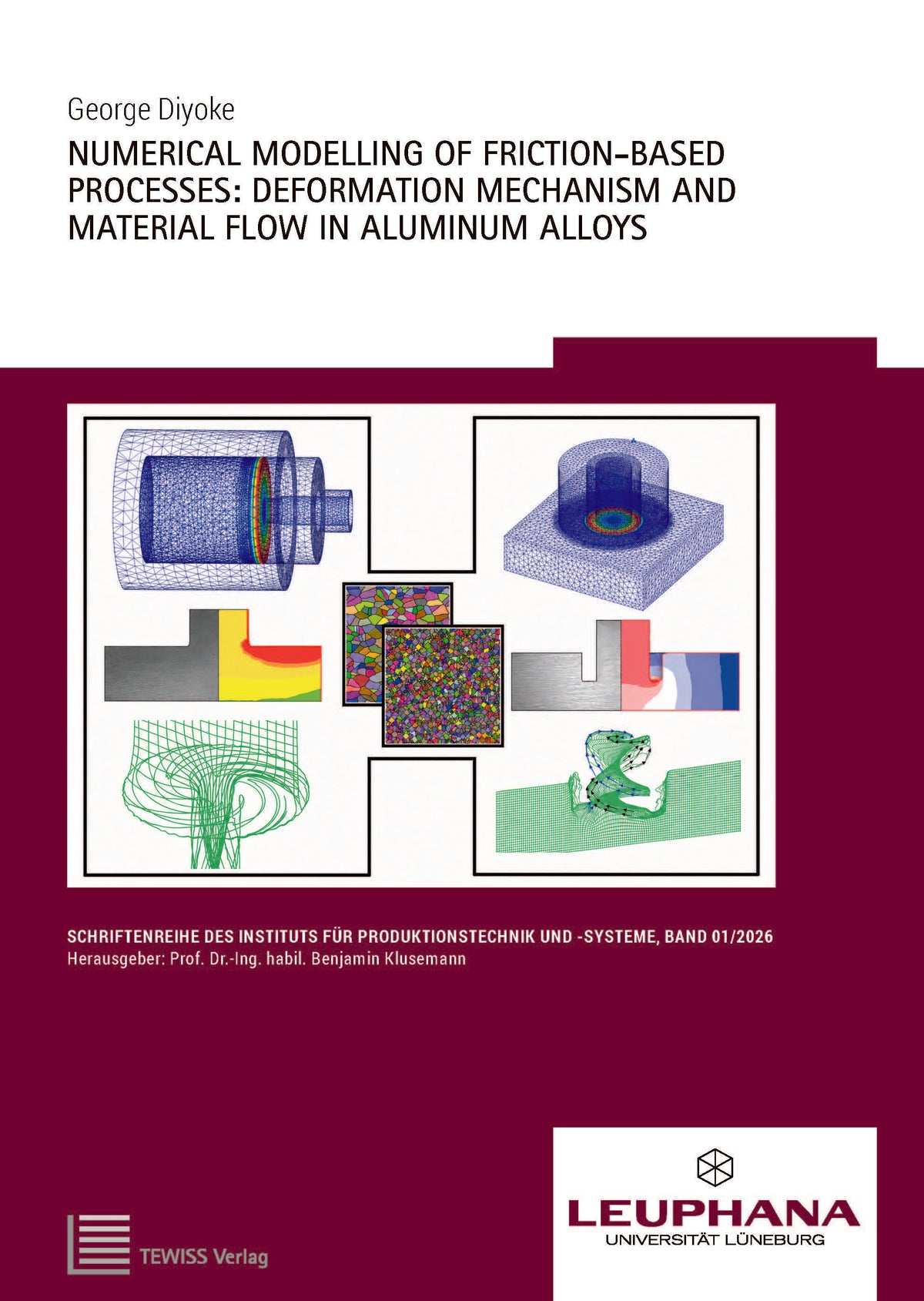
This study investigates conventional extrusion (CE), FE, and CFP using a combined numerical-experimental approach. A coupled thermo-mechanical finite element framework based on an incremental Lagrangian formulation is developed and extended to predict grain size evolution from thermo-mechanical process conditions. The framework evaluates the effects of friction regime, rotational speed, and extrusion ratio on material flow, grain refinement, and hardness in high-strength aluminum alloys.
The results show that die rotation transforms the predominantly axial compression of CE into shear-dominated flow in FE. Sticking friction promotes homogeneous shear deformation and grain refinement to approximately 2–3 µm, while sliding friction causes flow asymmetry, strain localization, and microstructural heterogeneity. Combinations of rotational speed, friction, and extrusion ratio enhance tool–workpiece interaction and radial material transport. In CFP, simultaneous shoulder and probe rotation produces constrained helical material flow and microstructural refinement, resulting in an approximately 25% hardness increase in AA7075 compared with the as-rolled condition.
Overall, this work establishes a process–flow–microstructure–property framework for friction-based solid-state processing and provides validated modeling tools for predictive process design and optimization of high-performance aluminum components.