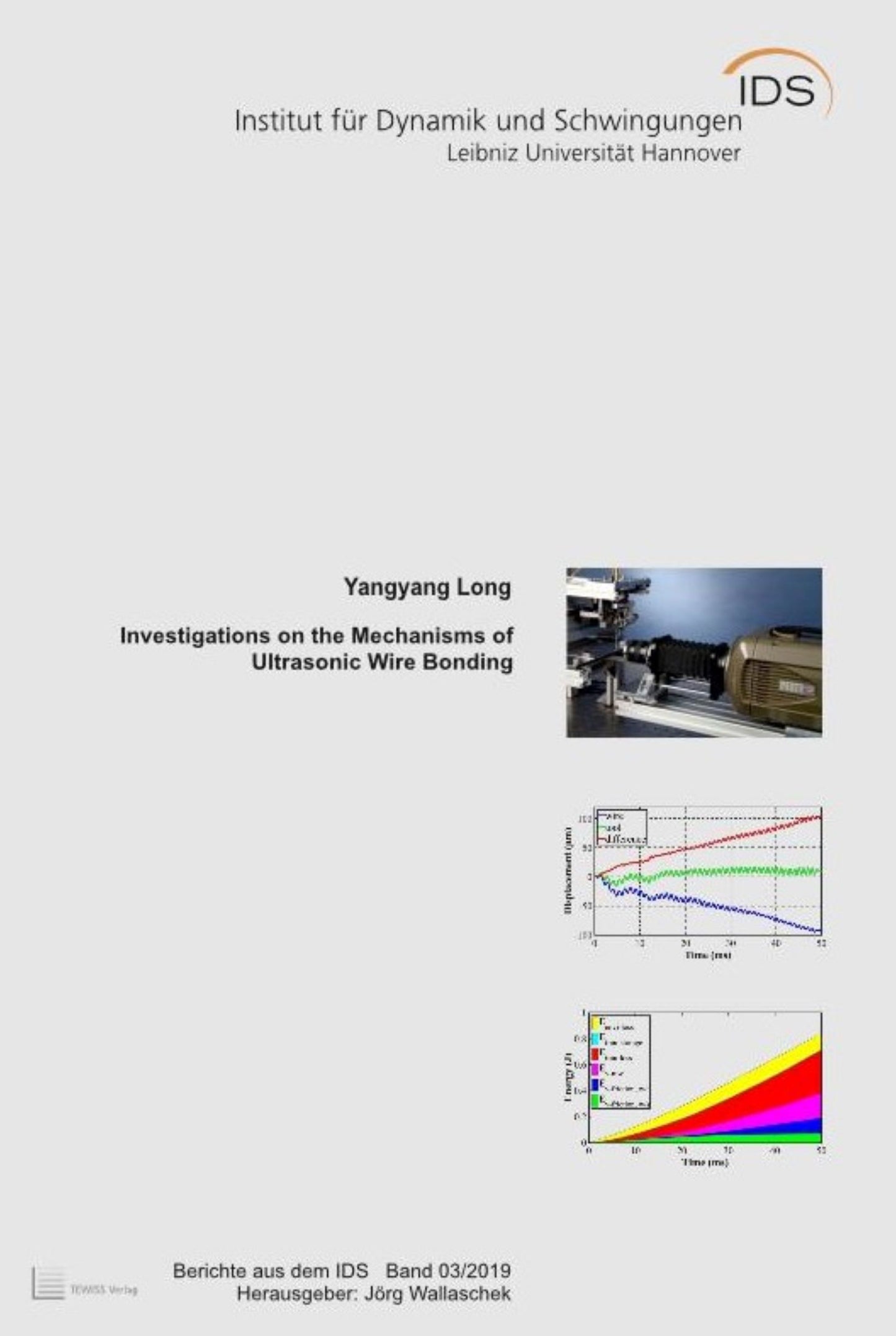

Investigations on the Mechanisms of Ultrasonic Wire Bonding
Autor*in: Yangyang Long
ISBN: 978-3-95900-327-8
Dissertation, Leibniz Universität Hannover, 2019
Herausgeber*in der Reihe: Jörg Wallaschek
Band-Nr.: IDS 03/2019
Umfang: 136 Seiten, 89 Abbildungen
Schlagworte: ultrasonic wire bonding, bonding mechanisms, relative motion, oxide removal, energy flow, Ultraschall-Drahtbonden, Verbindungsmechanismen
Kurzfassung: Optoelectronic devices are finding increasingly varied applications; this poses high requirements on packaging technologies. With the growing demand for mechanical flexibility, transparent polymeric films are being employed as substrates. The goal of my research is to create chip-on- flex packaging (CoF) for optoelectronic devices. However, due to films' low glass transition temperature, thermal loading must be minimized. Therefore, a novel bonding process — namely, optodic bonding — is developed. The optical performance is considerably impaired by inefficient heat dissipation; to address this challenge, different thermal management techniques are implemented. Simulative and experimental investigations are conducted to evaluate the performance of CoF packages. In addition, optical simulations are performed to explore the influence of positioning accuracy. Two prototypes of planar optical interconnects are fabricated, with multi- and single-mode polymer waveguides, respectively. For optimal coupling, active alignment is applied. Optical coupling efficiency is calculated accordingly, and data transmission capability is verified.